| This blog explores social attitudes in Jane Austen's time, discusses her novels, reviews forgotten 18th century novels, and throws some occasional shade at the modern academy. The introductory post is here. My "six simple questions for academics" post is here. Spoilers abound in my discussion of these forgotten novels, and I discuss 18th-century attitudes which I do not necessarily endorse. |
CMP#258 Emma, the feminist heroine--The Memoirs of Emma Courtney (1796) by Mary Hays
 Social justice warrior
Imagine that you have extricated yourself from a relationship with an intelligent but intensely passionate woman, and she writes to you to request the return of her letters—because she is planning to write a novel.
William Frend, faced with his situation in 1796, chose to “grey rock” her--as the kids say. He never returned the letters, so far as we know. Frend, an intelligent, principled, but rather didactic sort of a guy, was involved with radical circles in London during the heady times of the French Revolution. I discuss him in this previous blog post.
Hays’ fixation over Frend formed the basis of her 1796 epistolary novel, The Memoirs of Emma Courtney, in which she retraces their one-sided relationship. If Emma Courtney is a self-portrait, then Hays was an intelligent, articulate, but very self-absorbed woman, an impression reinforced for me by her letters. I should imagine her friends sighed inwardly when one of her lengthy epistles was handed over by the postman. I’m sure they were always advising her to just get out and go for a long walk.
“I can’t make you love me if you don’t,” as the Bonnie Raitt song says. This is a sad lesson that many young people must learn. But now that I check the dates, Mary Hays was 39 years old at the time that she was pursuing Frend.
 A portrait of a Jacobite, not a Jacobin
A portrait of passion
Scholars have noted that Emma Courtney is daring for its time in its expression of female passion. I don’t think Emma and Augustus [her representation of herself and Frend] have sex, but they pass a night together in the library during a violent thunderstorm, which stands as a proxy for sex. At one point Emma abandons the rules of female propriety to offer herself to Augustus as his mistress. “My friend—I would give myself to you” she writes, a line interpreted as a conscious play on Frend’s name.
The author shares her progressive and feminist ideas as we go along. The heroine bewails the gender role she is forced to play, and how her genteel upbringing has rendered her unfit to fend for herself. (In that respect, Mary Hays didn't have to look far for a role model for a woman who dirtied her hands with grubby commerce--her own mother ran a wine cellar and raised seven children after her husband died.)
However, I don't think Mary Hays succeeds in tying her political views to Emma's misery over unrequited love. You can't demand that the man you love reciprocates your love on the basis that women deserve social equality. And--not that this ever pricks the conscience of the heroine--her misery means the people who invite her to live with them in compassion for her poverty find themselves dealing with a miserable, weepy, self-absorbed houseguest. No Elinor Dashwood-style stoicism for Emma. No due consideration for others. True, this is Emma telling her story in the first person, so of course the book is about her, but Emma is essentially a solipsist, even though she regards herself as a virtuous person. As scholar Jonathan Wordsworth notes: ‘Virtue’ in this Jacobin context is not chastity… it consists in ‘the pursuit of truth, and the advancement of reason’…[and] in making oneself of utility to one’s fellow beings.”
Unrequited love, that’s basically the story. Except—near the end, Hays kills off Frend’s alter ego in the novel with a carriage accident. In real life, both Hays and Frend lived to a ripe old age. Frend married someone else. Hays never married.
Hays said she intended her portrait of Emma Courtney as a warning to others not to be carried away with their passions—so in the end, she does not advocate free love.
Hays is a talented writer, although she deploys commas, in a manner, which would strike us, today, as quite prolific.
Other aspects of the novel
Primogeniture: Augustus Harley, the character based on Frend, inherited the family estate because of the laws of primogeniture, but he “immediately sold the estate, and divided the produce, in equal shares, between each individual of the family.” Here Hays is championing the progressive view. Primogeniture, as discussed at other places in this blog, was a hot topic in the 1790s, and we see in this example that the only way to share a family estate equally is to dissolve the family assets. Nobody argued that primogeniture was fair—but it was intended to keep family estates together and hand them down through the generations. That's why "the family of Dashwood" in Sense and Sensibility had long been settled in Norland Park "for many generations"--because of primogeniture.
East and West Indies: The heroine’s cousin, Mr. Melmoth, comes back from the West Indies with a handsome fortune and has become “haughty, opulent, purse-proud [and] surrounded by ostentatious luxuries.” Emma and Augustus are invited to dinner at his place in company with an army officer. Emma proceeds to denounce the military and Augustus denounces slavery. It seems to me if you are going to inveigh against slavery, you wouldn’t do it while eating the beef and drinking the cognac purchased by your host with the avails of slavery, plus you wouldn’t call one of your fellow dinner guests a murderer, but that’s just me. I doubt if Mrs. Melmoth, the hostess, ever issued a return invitation to these two. And again, this is not a college freshman describing a visit to her MAGA uncle at Thanksgiving. This novel was written by a woman in her late thirties. Her long-time friend Henry Crabb Robinson said of Hays that she advanced her opinions with "more zeal than discretion."
 The Nightmare by Fuseli
More about the author--Mary Hays (1759-1843)
Discussing the real people behind this novel is more interesting to me than discussing the novel. Mary Hays grew up in a Dissenter household; that is, outside of the established church. She was accustomed, therefore, to think of herself as an outsider, and an outsider as a matter of principle. It's not surprising then that she had strong opinions about politics and society which she bestowed upon her heroine. Emma finds herself at odds with her own times and the institutions of society: “the study of law is the study of chicanery,” the “church [is] the school of hypocrisy and usurpation!” and universities “poison virtue at its source.” Unlike some of the other novels I've been reading, she does not merely critique the manners of the times, or chastise people who fail to live up to their duties. No, the institutions of society should be ripped up root and branch. Thus we can classify this novel as a Jacobin novel, not as a "lash the follies of the times" novel. As you might suppose, the conservative Anti-Jacobin Review was appalled by The Memoirs of Emma Courtney.
With its emphasis on emotion and suffering over actual plot, this is also a novel of sensibility. The blighted romance with Frend seems to have coloured the rest of Mary Hays’s life, according to the insightful foreword written by Marilyn L. Brooks for the re-issue of Emma Courtney in 2000. According to Brooks, Hays went on to form another unsatisfactory relationship with “the unstable and little-liked novelist, Charles Lloyd,” and he put her in his novel Edmund Oliver (1798) as the character Gertrude Sinclair. (Though some scholars say that Gertrude is based on Mary Wollstonecraft.)
Hays, Godwin and Wollstonecraft
Mary Hays greatly admired Mary Wollstonecraft, and she corresponded for a time with Wollstonecraft’s husband, the then-influential philosopher William Godwin, who appears in Emma Courtney as the stern but avuncular “Mr. Francis.” Hays reproduces some of their actual correspondence in the novel. Mr. Francis drifts out of the novel before the end, after vainly advising the heroine to look on the bright side and get on with her life, using the obvious talents she has: “You addressed a man as impenetrable as a rock, and the smallest glimpse of sober reflection, and common sense, would have taught you instantly to have given up the pursuit.” Actually, Godwin was about the last person you would turn to if you were in need of emotional consolation. He took a very cerebral approach to human relations.
Both Wollstonecraft and Hays had a propensity for forming obsessive feelings for people—to the point of risking their social standing, their happiness, and even their sanity. Wollstonecraft had an intense relationship with a female friend, who got married and went to Portugal. Wollstonecraft abandoned her fledgling girls’ school in Newington Green and travelled to Portugal to be with her in her final illness. Later, she became obsessed with the married painter Henry Fuseli, and her failed efforts to win back her straying common-law husband Gilbert Imlay led to a suicide attempt. Tragically, her brief marriage to William Godwin, which seems to have brought her a measure of contentment, ended with her death in childbed.
As for Hays, she tragically lost her first love to a fever shortly before they were to be married. Neither family approved of the relationship, which might have only added to the romance of it all. Hays's mother feared she was plunging into an imprudent match at a time when marrying without money could lead to real disaster--debtor's prison or near starvation.
Once she commenced on her writing career, Hays supported herself as a book reviewer, teacher, children’s book author and popular historian. This suggests that whatever notoriety that clung to her name did not completely debar her from finding work or putting her name on the title pages of her publications.
 Mary Hays' faded gravestone in Abney Park cemetery. East End Women's Museum website
Hays, according to Marilyn Brooks, was an unhappy woman, but she found what solace she could by looking after the children of her widowed sister. Hays was intelligent and better-learned than many of her female contemporaries, but she concluded her intelligence only caused kept her constrained within the bounds of gentility in a society which held women back from entering fields which were open to men. “Her final wish was granted when she was buried ‘in a humble grave… with the simple memorial Mary Hays engraved on the headstone.’”
Scholar Timothy Whelan has established a valuable website about Mary Hays, her circle, and her life and times. It includes reviews of her writings, including Emma Courtney. In addition, much of her correspondence is preserved. Her love letters to her first love, Mr. Eccles, are the self-conscious products of a youthful pen. Two samples here from 20-year-old Mary which sound like Marianne Dashwood from Sense & Sensibility:
Scholar Timothy Whelan has established a valuable website about Mary Hays, her circle, and her life and times. It includes reviews of her writings, including Emma Courtney. In addition, much of her correspondence is preserved. Her love letters to her first love, Mr. Eccles, are the self-conscious products of a youthful pen. Two samples here from 20-year-old Mary which sound like Marianne Dashwood from Sense & Sensibility:
| "How pleasing was our ramble on Thursday – to a well formed mind there are ten thousand charms in the lovely simplicity of nature, which are in vain sought for amongst the works of art. – How little do mankind know their own happiness – there is no luxury like the luxury of the heart! what the generality of the world call pleasure, to souls capable of thinking properly, is all tasteless insipidity..." |
| "Tis midnight! silence and darkness surround me – best hour of musing for a mind deprest! – We must part – perhaps an eternal separation! – It has been a fatal attachment – a source of distress from its commencement! – my heart bleeds for you! – would to God, it was in my power to extricate you from the difficulties in which you are involved – Fortune is unjust..." |
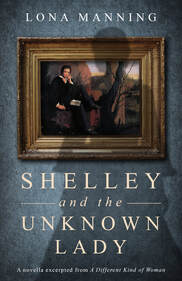 Godwin and Wollstonecraft are mentioned, but do not appear, in my novella, Shelley and the Unknown Lady. It concerns a real-life mystery in the life of the poet Percy Bysshe Shelley while he was living in Italy with his wife Mary Shelley. I solve the mystery by introducing Mary Crawford from Mansfield Park into the narrative. I share some of my research into the Shelley/Godwin/Wollstonecraft family here. The memorial statue erected to Mary Wollstonecraft in Newington Green is absolutely hideous and badly proportioned. It looks like a splurge of water with a little naked Barbie doll stuck on top. |  |
| Brooks, Marilyn L. foreword to Memoirs of Emma Courtney / Mary Hays. Broadview Press, 2000. Robinson, Henry Crabb. Diary, Reminiscences and Correspondence of Henry Crabb Robinson. J.R. Osgood, 1871. Wordsworth, Jonathan. The bright work grows: women writers of the Romantic Age. Woodstock Books, 1997. |
 RSS Feed