LONA MANNING
  • Home
  • Books
    • Shelley Novella
  • Research
    • Kitty Riddle
    • 18th C. love poetry
    • About Shelley
    • Peterloo
  • Jane Austen
  • Blog
  • About Me/Contact
    • Publications
    • Teaching Philosophy

CMP#213 Guest post: Dick and Richard

4/1/2025

0 Comments

 
Picture

   This blog explores social attitudes in Jane Austen's time, discusses her novels, reviews forgotten 18th century novels, and throws some occasional shade at the modern academy. ​The introductory post is here.  My "six simple questions for academics" post is here. 
     Today I am pleased to share a thought-provoking guest post by Prof. Lily A. Soda, on the hidden political message behind Austen's harsh comments about Dick Musgrove in 
Persuasion. ​

    
CMP#213  Guest Editorial: The reason for Dick Musgrove in Persuasion
PictureFat Shaming: Mrs. Musgrove's "large fat sighings" over Dick
​​     Many of Jane Austen’s devoted readers feel surprise and consternation over the passages in Persuasion about "troublesome, hopeless" Dick, the deceased son of the Musgrove family, along with the mocking depiction of his sorrowful mother. Austen doesn’t pull her punches in describing Dick as “stupid and unmanageable" and as someone who "had been very little cared for at any time by his family, though quite as much as he deserved.” His death far from home was “scarcely at all regretted.”
​   
Some scholars have surmised that, had Austen not been in the throes of her final illness, she would have revised her callous descriptions or excised them altogether. Others have speculated about why Austen inserted these harsh passages in a novel famous for its gentle heroine and its wistful tone.
   Could it be that these strongly-worded passages hint at something Austen felt strongly about? Her seemingly out-of-place attack on the Musgroves is intended to catch the reader’s attention, to provoke them to pause and probe beyond the liminal space of the Musgrove's drawing room and to confront the costs of empire which supports their way of life. Indeed, we were mistaken in taking these passages at face value.
​    Dick Musgrove may well have been a satiric, inverted portrait of a real-life Richard who served in the Navy—Richard Parker, infamous in Austen’s time but forgotten today.


Read More
0 Comments

CMP#180  The hidden truth about Austen's Emma

4/1/2024

0 Comments

 
Picture

Here's a special post for Janeites -- the insights in today's blog post will be intelligible only to people who are well acquainted with the plot of Jane Austen's masterpiece Emma.

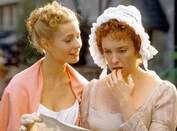
CMP# 180    Guest Blog: "It is a certainty. Receive it on my judgment."
Picture
   Dear Readers:
​   I recently received a flurry of emails from a well-known (if controversial) Jane Austen researcher asking to rebut my "completely misguided" comments about Jane Austen's novel Emma. He said I was "blissfully unaware" of the real reason that Emma Woodhouse prevented Harriet Smith from marrying Robert Martin. His theory is that Emma contains several hidden plots, all of which indicate Austen's truly radical beliefs.
   In a gesture of good faith, I have agreed to share his theory that a dramatic “subterranean story” (one of many) lurks beneath the placid surface of Emma. What follows are his insights, not mine:
Read More
0 Comments

CMP#138 Guest Post: Jane Austen, Anti-Capitalist

4/1/2023

2 Comments

 
Picture
It's always a pleasure to encourage young scholars, so I'm pleased to welcome Lura Amandan to "Clutching My Pearls" this week. Ms. Amandan is a postgraduate student at the University of Reinlegen in Germany. Her doctoral thesis is focused on early critiques of capitalism in European literature, and with the kind permission of her faculty advisors, I am sharing an excerpt from her truly groundbreaking work-in-progress concerning Jane Austen and capitalism. My six questions for Austen scholars post is here.

Jane Austen, "A Marxist Before Marx"
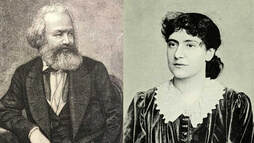
PictureKarl Marx and his daughter Eleanor: was her name inspired by Austen? (Source: British Library)
    ​As many scholars of Austen have long pointed out, Jane Austen intended to use Sanditon to explore the social and moral consequences of capitalism. Sadly, Austen laid the manuscript aside during her final illness. Interrogating Austen through a critical lens reveals that she was a committed anti-capitalist who was determined to fight back in the only way she could--through her pen.
    I am not referring to Austen's well-known portrayals of the landed gentry and the lesser nobility, but rather, her subtle attacks on the pernicious influence of consumerism. To a startling extent, the buying and selling of things and the rise of the
 urban bourgeoisie forms a backdrop to her so-called marriage plot novels. Scholar David Daiches called Austen "a Marxist before Marx." 
   
   It is no exaggeration to say that Austen shows us whether a character is good or bad by their reaction to consumerism. Two of Austen’s heroines never step inside a store--Elizabeth Bennet and Fanny Price. And, significantly, the heroines who do go shopping always live to regret the experience. It is only the fops and fools who like to shop, as we will see. Austen’s message could not be clearer: Capitalism is the root of all evil. Let’s critically take the novels one by one...


Read More
2 Comments

CMP#100  Six Critical Questions

5/8/2022

1 Comment

 
Picture
Many modern readers who love Jane Austen are eager to find ways to acquit her of being a woman of the long 18th century. Clutching My Pearls is my ongoing blog series about my take on Jane Austen’s beliefs and ideas, as based on her novels. Click here for the first in the series.  

My One Hundredth Blog Post: Six Critical Questions, or Much Ado About Hedges
PictureWas she radical?
    Since I started Clutching My Pearls, I’ve read a lot of Austen scholarship, some of which I've found informative and thought-provoking, but some of it I've found to be agenda-driven and influenced by presentism.
    Granted, I'm not an academic. My eyes glaze over at mentions of Derrida and Foucault—all that stuff is just beyond me. I'd like to know more about Austen's contributions to the development of the novel, but modern scholars have moved beyond that. Or rather, they seem to take it for granted that Austen was writing at such an advanced level of subtlety and symbolism that the merest object or reference—an apricot, a shawl, a hedge, a surname—can unlock the key to a hidden level of meaning that exists underneath and often in contradiction to the narrative. I'm unconvinced: would an author of her time, even an author of genius, write novels about happy marriages that aren't really about happy marriages at all?
    I have no quarrel with individual reactions to Austen, or with what people draw out of Austen. But I do differ with those who ascribe improbable opinions to Austen, hence the following rebuttal.
   For my 100th blog post, I offer six simple questions which I think academics might profitably ask themselves when formulating their theories about who Jane Austen was, and what she believed...


Read More
1 Comment
<<Previous

    RSS Feed

    About the author:

    Greetings! I blog about my research into Jane Austen and her world, plus a few other interests. My earlier posts (prior to June 2017) are about my time as a teacher of ESL in China (just click on "China" in the menu below). More about me here. 


    Categories

    All
    18th Century Novel Tropes
    Authoresses
    Book Reviews
    Books Unreviewed Til Now
    China
    China: Sightseeing
    Clutching My Pearls
    Corvey Collection
    East & West Indies & Slavery
    Emma
    Humour
    Jane Austen
    Laowai At Large
    Mansfield Park
    Northanger Abbey
    Parody
    Persuasion
    Postmodern Pushback
    Pride And Prejudice
    Religion & Morality
    Sanditon
    Sense And Sensibility
    Shelley
    Teaching
    Woman Of Colour Mystery

    Archives

    December 2025
    November 2025
    October 2025
    September 2025
    July 2025
    June 2025
    May 2025
    April 2025
    March 2025
    October 2024
    September 2024
    August 2024
    July 2024
    June 2024
    May 2024
    April 2024
    March 2024
    February 2024
    January 2024
    December 2023
    November 2023
    October 2023
    September 2023
    August 2023
    July 2023
    May 2023
    April 2023
    March 2023
    February 2023
    January 2023
    December 2022
    October 2022
    August 2022
    July 2022
    June 2022
    May 2022
    April 2022
    March 2022
    February 2022
    January 2022
    December 2021
    November 2021
    October 2021
    September 2021
    August 2021
    July 2021
    June 2021
    May 2021
    April 2021
    March 2021
    February 2021
    January 2021
    December 2020
    November 2020
    October 2020
    December 2019
    November 2019
    January 2019
    January 2018
    October 2017
    June 2017
    May 2017
    January 2017
    January 2016
    December 2015
    November 2015
    October 2015
    September 2015


    RSS Feed

    © Lona Manning 2024
Proudly powered by Weebly