LONA MANNING
  • Home
  • Books
    • Shelley Novella
  • Research
    • Kitty Riddle
    • 18th C. love poetry
    • About Shelley
    • Peterloo
  • Jane Austen
  • Blog
  • About Me/Contact
    • Publications
    • Teaching Philosophy

CMP#166   Sir Edward, the principled hero

12/28/2023

0 Comments

 
Picture
Clutching My Pearls is dedicated to countering post-modern interpretations of Jane Austen with research that examines her novels in their historical and literary context. I also read and review the forgotten novels of the Georgian and Regency era and compare and contrast them with Austen's. Click here for the first post in the series. Click here for my six critical questions for scholars.

CMP# 166    Book Review: The Wife and the Lover (1813), (not to mention the idiotic husband)
PictureIf you really loved me: Image generated by Bing AI
    The Wife and the Lover is not about a wife who has an affair, as I first surmised. “Lover” in this case refers to a unrequited love, or chivalric love. We first meet the darn-near-perfect hero, Sir Edward Harcourt, talking with his guardian and mentor, Lord Fanshaw. Fanshaw warns Sir Edward, who has recently inherited his baronetcy, to think twice before marrying the beautiful and accomplished Cecilia Fitzallard. Lord Fanshaw does not object to the fact that Cecilia does not come from a distinguished family, or have a large fortune; the problem is that she is rather too full of herself, and apt to take offence where none was intended.
     Sir Edward, however, is head-over-heels for Cecilia.
   Lord Fanshaw’s own wife Horatia accidentally proves that the lord had a point; when Horatia makes some joking remarks about Cecilia, which are carried back to her by a character helpfully named Tabitha Wormwood, Cecilia is incensed. She demands that Sir Edward cut off ties to the Fanshaws immediately and forever.
    Our hero can’t do it; he owes the Fanshaws, especially Lord Fanshaw, “both gratitude and esteem." Cecilia, accusing him of not loving her enough, breaks off the engagement. Sir Edward leaves his affairs in the hands of his steward and goes abroad to heal his broken heart.
    Cecilia has many other admirers, including a visiting German count who is a renowned soldier back in the German principality of *****. Count Falkenstein had an “unfavorable opinion” of “women in general, nor could he forbear to express his disapprobation of the freedom which the English ladies, both before and after marriage, enjoyed.”
    A little foreshadowing here: we are told that the count is honorable, brave, handsome, and noble, but he expects unquestioning obedience from a wife. After he and Cecelia are married, he writes to his relatives back in Germany to assure them that she is not like the other outspoken English ladies: “My lovely bride has a just conception of the gentle duties of her sex, and adores that nice sense of honor which cannot tolerate the levity too prevalent in a country where the fair sex enjoy almost unlimited liberty,”
    So, are we setting up for a story where the heroine realizes, too late, that she threw away a wonderful man and rashly married a tyrant? You might think so. You might assume that the narrator is going to take Cecilia’s side in what follows.


Read More
0 Comments

CMP#159 Isabel & Elizabeth, the dutiful heroines

10/31/2023

0 Comments

 
Picture
This blog explores social attitudes in Jane Austen's time, discusses her novels, reviews forgotten 18th century novels, and throws some occasional shade at the modern academy. ​The introductory post is here.  My "six simple questions for academics" post is here. ​

CMP#159  More reviews for forgotten books
PictureMorally improving
    The previous forgotten book I reviewed, The Metropolis, dwelt on the seamier side of London life; the fleshpots of Covent Garden and the propensity of wealthy people to destroy their lives over a game of cards. The next novel I picked up, alas, instantly delved into the same theme, but there is a big difference between the two titles which is worth noting in light of the debates which were raging at that time over the morality and propriety of reading novels.
     The Metropolis received no reviews but if it had, I think the reviewers would have called it a book--to use their phrase--that you could not safely put into the hands of your daughter or sister. It is too detailed in its depiction of vice, and the vices and crimes committed in the book (fornication, gambling, cheating at gambling, highway robbery) are not sufficiently condemned or punished. The Decision (1811), while going over much of the same ground, and in fact including a main character who commits criminal acts, would be safe for a girl to read because it is overtly religious and didactic. A reviewer said: “We trace in these volumes a laudable endeavour to convey as much moral instruction as could be admitted into a work of fancy.” Yes, The Decision is stuffed like a plum pudding with the wholesome raisins of morality. The title refers to the heroine's decision to put her father's wishes ahead of her own, and later, to turn down a fortune in exchange for marriage.
     The Decision begins with a long and confessional letter from Charles Arundel to his old friend Mr. Beverly. Arundel married for love but becomes a gambler and a philanderer. At his dying uncle’s bedside, he sees that he’s been cut out of the will, which would lead to his ruin. He destroys the will and even poisons the uncle. He lives with his guilt until later on in life, after he is widowed, he decides to go to the West Indies and meet the young relative whose father was unknowingly cut out of the will.
    The mention of the West Indies will bring thoughts of slavery to mind for the attentive modern reader, but there is no mention of slavery or colonial exploitation as a sin or even as a cause of remorse in this book--a book which features many people who do things that they regret, such as marrying for ambition. Once again the West Indies are a plot device to remove the father from the action, so the heroine can live with the Beverly family.


Read More
0 Comments

CMP#148  Book Review: Modern Manners

8/17/2023

0 Comments

 
Picture
This blog explores social attitudes in Jane Austen's time, discusses her novels, reviews forgotten 18th century novels, and throws some occasional shade at the modern academy. ​The introductory post is here.  My "six simple questions for academics" post is here.

CMP#148  Book Review: Modern Manners, or, a Season at Harrowgate (1817)
Note: I've included details  that resemble Austen, while leaving it to my clever readers to spot them.​
PictureHarrogate spa well, Wikicommons, detail
Synopsis
   Modern Manners, an 1817 novel by an anonymous authoress, starts with the marriages of the parents of our main characters. Amelia has the good luck to captivate Henry Fitzgerald, a “gentleman from the Indies” (aka a man with a colonial fortune) who all the “Mamma’s” of the neighbourhood are angling after. Amelia’s match means she goes off to live in London and mingle with the ton. Her sister Matilda marries Mr. Oswald, a respectable vicar with a small independent fortune. Matilda “sighed at the idea of… her sister [Amelia] being lost in the fashionable vortex of dissipation and vanity."  
   The years pass, the countrified Oswalds have a daughter and the city-dwelling Fitzgeralds have two sons and a daughter. Mr. Fitzgerald becomes an MP and then is elevated to the peerage; now, instead of being the wife of a nouveaux riche Indian nabob, Amelia is Lady Fitzgerald. An easy-going woman of no strong opinions, Amelia is more engaged with her morning visits and playing cards than paying attention to the education and moral upbringing of her daughter Julia.
​     The Fitzgeralds come to visit the Oswalds and their lovely, sensible, daughter Emma. Julia Fitzgerald is a social butterfly and an enthusiast for Rousseau, rugged scenery, and defying whatever it is her parents want her to do. We learn that the oldest son, Frederic, is not very attentive to his fiancée. She is Elvina Dorrington, an Indian heiress. Emma Oswald, our main heroine, is intelligent, principled, and sincerely devout, and the author struggles to make her as interesting as Elvina and Julia...  


Read More
0 Comments

CMP#143   A Knave or a Fool

5/11/2023

0 Comments

 
Picture
This blog explores social attitudes in Jane Austen's time, discusses her novels, reviews forgotten 18th century novels, and throws some occasional shade at the modern academy. ​The introductory post is here.  My "six simple questions for academics" post is here.

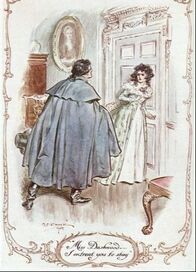
PictureShocker!
“Do you think me most a knave or a fool?” 
    In the previous post I discussed the possibility, floated by Austen expert Robert Morrison, that Marianne Dashwood was hiding a secret pregnancy in Sense and Sensibility. After a careful re-read of the novel, I've concluded that making Marianne pregnant contradicts the central preoccupation of the main characters as reiterated throughout the conclusion of the novel. To explain what I mean, let's start by recapping the set-up for the dramatic scene when Willoughby arrives at Cleveland, the country estate of Mrs. Jenning's daughter, late at night.
   
 Marianne Dashwood fell seriously ill at Cleveland on her return trip from London. Her hosts, Mr. and Mrs. Palmer, leave the house so their baby does not catch Marianne's infection. Their other house guest, Colonel Brandon, hurries off in his carriage to fetch Marianne's mother. That leaves Elinor, Mrs. Jennings, and the servants.
​     Marianne is feverish and delirious, but fortunately she pulls through and falls into a restful sleep. Once she is pronounced out of danger by the apothecary, Mrs. Jennings goes to her own room "to write letters and sleep." Elinor is too happy to sleep, so she is sitting by Marianne's bedside when she hears a carriage arrive. She summons Betsy, Mrs. Jenning's maid, to stay with Marianne and she goes downstairs. To her shock, it's Willoughby, the cad who jilted her sister. He explains he came to Cleveland to persuade Marianne and Elinor to hate him "one degree less" than they surely must "do now."  He exclaims: "Tell me honestly... do you think me most a knave or a fool?”
   Who cares if Willoughby had the opportunity to rehabilitate his character? Who cares if we “hate [him] one degree less than [we] do now”? I know I wouldn't have given him the patient hearing that Elinor did, so I didn't miss the absence of this scene in the 1995 movie. However, as I carefully re-listened to the book, I finally get what Willoughby was driving at...

Read More
0 Comments
<<Previous
Forward>>

    RSS Feed

    About the author:

    Greetings! I blog about my research into Jane Austen and her world, plus a few other interests. My earlier posts (prior to June 2017) are about my time as a teacher of ESL in China (just click on "China" in the menu below). More about me here. 


    Categories

    All
    18th Century Novel Tropes
    Authoresses
    Book Reviews
    Books Unreviewed Til Now
    China
    China: Sightseeing
    Clutching My Pearls
    Corvey Collection
    East & West Indies & Slavery
    Emma
    Humour
    Jane Austen
    Laowai At Large
    Mansfield Park
    Northanger Abbey
    Parody
    Persuasion
    Postmodern Pushback
    Pride And Prejudice
    Religion & Morality
    Sanditon
    Sense And Sensibility
    Shelley
    Teaching

    Archives

    September 2025
    July 2025
    June 2025
    May 2025
    April 2025
    March 2025
    October 2024
    September 2024
    August 2024
    July 2024
    June 2024
    May 2024
    April 2024
    March 2024
    February 2024
    January 2024
    December 2023
    November 2023
    October 2023
    September 2023
    August 2023
    July 2023
    May 2023
    April 2023
    March 2023
    February 2023
    January 2023
    December 2022
    October 2022
    August 2022
    July 2022
    June 2022
    May 2022
    April 2022
    March 2022
    February 2022
    January 2022
    December 2021
    November 2021
    October 2021
    September 2021
    August 2021
    July 2021
    June 2021
    May 2021
    April 2021
    March 2021
    February 2021
    January 2021
    December 2020
    November 2020
    October 2020
    December 2019
    November 2019
    January 2019
    January 2018
    October 2017
    June 2017
    May 2017
    January 2017
    January 2016
    December 2015
    November 2015
    October 2015
    September 2015


    RSS Feed

    © Lona Manning 2024
Proudly powered by Weebly